
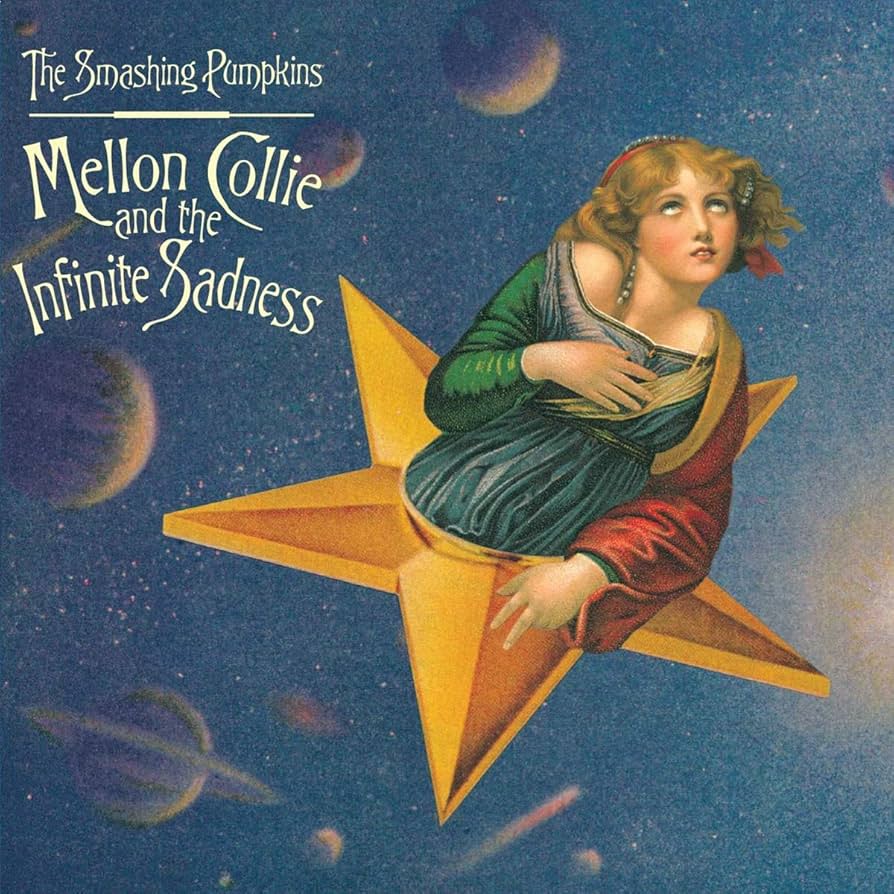
As their masterpiece turns 30, here’s why we should treasure Billy Corgan and the Smashing Pumpkins
Thirty years ago Smashing Pumpkins’ Mellon Collie & The Infinite Sadness essentially brought the curtain down on the alternative rock era with an album that was heavier, lighter, weirder, poppier, uglier and more beautiful than any other guitar record of the decade. A 28-track, double disc that took in screaming metal, proggy epics, acoustic lullabies, electronic-tinged pop, orchestral ballads and cute pastiches. It was an astonishing achievement and a huge swing. A band in their pomp, seemingly bulletproof, with or without the butterfly wings.
By 1995 the Pumpkins – frontman, songwriter and guitarist Billy Corgan, bassist D’Arcy Wretzky, guitarist James Iha and extraordinary drummer Jimmy Chamberlin – had ascended into the alt-rock big league. 1993’s Siamese Dream had been an attempt to capture a sort of sonic perfectionism unheard of on major label rock albums since the 70s. The studio polishing job, marshalled by co-producer Butch Vig, had driven just about everyone involved insane and came within a gnat’s whisker of breaking the band up entirely, but it had, importantly, worked. The record was a massive success, producing evergreen Gen X anthems ‘Today’ and ‘Disarm’ and selling something like four million copies in its first two years on sale. By 1994 the band were headlining Lolapalooza and booked to top the bill at the following year’s Reading festival. With the death of Kurt Cobain and Pearl Jam’s circling of the wagons and retreat into awkwardness with Vitalogy, Smashing Pumpkins, the awkward outsiders of a generation that had made outsiderdom its defining characteristic, were legitimately leading the scene.
When you’re in that position you have two choices. Basically, you can be Marc Bolan or you can be David Bowie. Neither choice is wrong. Both were once the biggest names in glam rock. Bolan decided to play it safe and “give the kids what they want”, following Electric Warrior with The Slider and Tanx. Great records, but more of the same, basically. Consolidate your position. Make your money while the sun shines. Then there was Bowie, who followed Ziggy Stardustwith Aladdin Sane with Diamond Dogs with Young Americans: records that took chances, stretched into new directions and risked alienating the teeny bopper audiences that bought ‘Starman’. Most of the bands that came up in the post-Grunge era, the likes of Creed, Live and Candlebox, opted for the former. The true originals, Nirvana, Pearl Jam, the Pumpkins, took the Bowie route. Take big swings. Confound your audience. Zig when they expect you to zag. Don’t give them what they want, give them what you want. It might well turn out to be what they needed all along. That’s how you get to an album like Mellon Collie & The Infinite Sadness.
Working with Flood, the English producer who’d helmed records as varied as U2’s Joshua Tree, PJ Harvey’s To Bring You My Love and Nine Inch Nails’ The Downward Spiral, the band abandoned the sonic polish of Siamese Dream for the fiercer, louder, hungrier sound they’d developed as an astonishingly well-drilled and dialled-in live band. Heavier songs were recorded with a full band on the studio floor (though Corgan later admitted to redoing a lot of the guitar and bass himself, as he had on the band’s previous albums), giving the record far more of an organic urgency. It was an album with real teeth, unafraid to be messy, even ugly at times. That’s how we get to songs like the extended, grinding and bitterly furious ‘XYU’ or early-doors banger ‘Jellybelly’, the propulsive, nagging ‘Bodies’ or kick-off single and era-defining anthem ‘Bullet With Butterfly Wings’. Across such pounding slobberknockers Billy Corgan could truly unleash his snarl in a way he hadn’t before. He’s less mannered here than on earlier Pumpkins material; more unhinged. You can hear it in his guitar solos too, especially on ‘(Fuck You) An Ode To No-One’ which layers panting, manic, desperate-sounding screams until the song disintegrates into sonic shredding culminating in Corgan literally hurling his guitar across the studio, scything into his cab.
Oddly, going as ugly and as heavy as they possibly could seemed to free the band up to push away from that baseline menace and, somehow, be prettier and poppier than at any other point in their career … on the same album on which they were at their heaviest. Fans who’d loved the shimmering alt-rock of Siamese Dream and then been lulled (or possibly provoked) into expecting brutal heaviness by the success of the ‘Bullet…’ single pressed play on disc one of their freshly-unwrapped Mellon Collie to find an instrumental piano ditty followed by ‘Tonight, Tonight’ a ballooning, glorious classic rock song smothered in strings. ‘Bullet With Butterfly Wings’ had promised darkness, but here was an explosion of technicolour and light. And just when you’ve got a handle on that, the album hits you with the thunder of ‘Jellybelly’. It’s a masterpiece of sequencing. Those that hadn’t bought the album and knew the band through their radio hits would be further confounded when the next single dropped. ‘1979’ was a drum machine-powered exercise in clockwork pop nostalgia that nodded to Corgan’s beloved New Order as much as ‘XYU’ did to Black Sabbath and ‘Tonight, Tonight’ to Wings or ELO. You realise that this was an album that could go anywhere. (By the way. I’m sorry. I really am. But if a band in 2025 wrote ‘1979’ they’d have to call it ‘2009’. Again, I’m so sorry.)
And go anywhere, it did. In fact, it went everywhere. James Iha wrote some lullabies. Corgan included the acoustic demo of ‘Stumbeline’ because he couldn’t better it in the studio. One guitar, one vocal. There’s the cute pastiches of ‘We Only Come Out At Night’ and ‘Lily (My One And Only)’, the sheer melodrama of ‘Porcelina of the Vast Oceans’ and ‘Thru The Eyes of a Ruby’, which makes up for ‘Stumbline’s’ one-guitar by giving us 30 at once. People often argue that double albums would work better if they cut the indulgences down to one disc of gold, but that’s missing the point: those indulgences are a feature, not a bug. That’s the point of double albums. To have room to play. To fill the corners with something you’d dismiss on a tighter record. That’s the joy of them.
And it worked. The album was colossal. It made the Pumpkins amongst the biggest bands on the planet. It sold by the pallet-load. It absolutely connected in ways lots of “conventional” wisdom said shouldn’t happen. The following two-year tour was monstrously successful, too. A band that had once said they’d refuse to play huge spaces in favour of five-night-stands in little clubs, found themselves visiting hockey arenas and basketball stadiums across the world, wrecking them as they went. Few bands have been as blistering as Smashing Pumpkins in 1996, as the live tracks on the new Mellon Collie30th anniversary re-issue attest.
And then, of course, it all fell apart. The death of touring keyboardist Jonathan Melvoin and the subsequent firing of Chamberlin sent the band spiralling. Adore was another big swing, a gorgeous curveball, but this time one that didn’t connect commercially. The follow up, MACHINA/The Machines Of God, was completely out of step with its era, intentionally so. This time, however, the wider audience had been distracted by Limp Bizkit and they weren’t coming back. By 2000 the original Pumpkins were done. What followed was complicated. A new band, Zwan, a summery exercise in 70s folky jams and Beatlesy pop flared briefly and collapsed. A Billy Corgan solo album arrived and departed with muted responses. He bought the Pumpkins back in 2007 with Zeitgeist, Chamberlin back behind the kit, and delivered something genuinely heavy and vital — an album that deserved better than the reflexive dismissal it received from critics, but the audience seemed happy to nod from afar and wait to see what happened next. And then Chamberlin left again, and things got difficult.
The period following Chamberlin’s second departure is where the real wilderness lies. Here was Corgan, the last Pumpkin standing, Mark E Smithing a band that bore his creation’s name but often lacked the chemistry that had defined it. The music wasn’t bad, by any means, but could sound uncertain of itself in a way Corgan rarely had before — unappreciated by the press, largely ignored by the public, and audibly lacking in confidence as a result. Oceania (2012), gorgeous vintage synths and a return to the Siamese Dream pedal board was solid enough and it scraped back some good will. But not enough. Never enough. Another change of personnel, another solid, but under-appreciated album in Monuments For An Elegy (2014). For a while it felt like the momentum had gone. Even Billy Corgan thought so. The next Pumpkins album was scrapped. He made a pretty, low-key acoustic record with Rick Rubin, instead. And that could of been all she wrote.
Except that’s not what happened. Not even slightly.
The reunion of OG Pumpkins Corgan, Iha and Chamberlin in 2018 (alongside long-serving wilderness-years Pumpkin Jeff Schroeder) to do an arena tour of 90s-era material could have been a nostalgia cash-in, a victory lap playing the hits. They did, after all, sell a lot of tickets and they did, after all, play the hits. The ‘Shiny and Oh So Bright’ tour, though, was far more than that. A lavish stage set, bold cover songs and a willingness to investigate both the big guns and deep cuts of the catalogue made this feel worthy of the Pumpkins of old in a far more legitimate way. And they’ve carried on from there, in that spirit. What’s remarkable about the Pumpkins’ third (or is it fourth? Or fifth?) act is that they’ve matched a commercial resurgence with a creative output that’s been genuinely, sometimes maddeningly, ambitious. More than that, they sound confident again. Not the brittle confidence of someone with something to prove, but the settled assurance of artists who know exactly what they’re doing even when what they’re doing is wilfully perverse. Since getting the band back together they’ve released four albums (five if you count the newly liberated Zodeon At Crystal Hall, a lockdown project finally getting a release, vinyl-only, this week), a 33-track rock opera released in instalments, and now an actual opera. Billy Corgan, it turns out, is finding ways to give the kids what they want, even if those kids are now 45, and make the music he wants. It turns out that it’s still what we need.
The Rick Rubin-produced Shiny And Oh So Bright, Vol. 1 was a tentative first step — eight songs, barely half an hour, described by Corgan himself as not-quite a proper album. But it proved the reunion could work, that the band chemistry could be greater than the sum of the parts. Then came Cyr, a 20-track double album that wrong-footed everyone expecting a Siamese Dream retread. Here was Corgan diving headlong into his beloved synth-pop, chasing the ghosts of Siouxsie and the Banshees, Sisters of Mercy and Joy Division. Tracks like ‘The Colour of Love’, all arpeggiated synthesizers and goth-club drama, are about as far from ‘Cherub Rock’ as you could reasonably get while still being recognisably the same songwriter. It was Corgan’s best single in a decade. The Guardian called it “a synth-fuelled endurance test,” which rather missed the point. This wasn’t Corgan failing to write rock songs; it was Corgan refusing to.
Because that’s one of the points of Billy Corgan and the Smashing Pumpkins. We need artists happy to unsweeten the pot, to draw the honey out and replace it with vinegar in the name of art. Those experiments are never going to be successful every time, but a world in which our premier league rock stars keep “giving the people what they want” will always be one where everything becomes contrived and homogenised. If there’s no big swings then there’s not going to be any home runs either.
ATUM, the three-act rock opera released across 2022 and 2023, pushed even further into wilful eccentricity. Billed as a sequel to both Mellon Collie and MACHINA, it followed the character introduced in the former as “Zero” and renamed “Glass” on the latter, now called “Shiny”, through a sprawling conceptual dystopia. At 33 songs and nearly two and a half hours, it was a lot. But, again, being a lot was the point. And scattered throughout the excess were moments of genuine brilliance. It was messy, brilliant, frustrating and fascinating in roughly equal measure. A rock folly in the grand tradition; one of those sprawling projects embarked upon by artists in their pomp, another big swing for the stars that has falling short built proudly into its DNA precisely because the target is something grandly unreachable.
The band’s most recent album, last year’s Aghori Mhori Mei,pulled off something unexpected: focus. Corgan set out to see whether the methodology of his imperial phase could still produce something vital. It’s the most guitar-forward Pumpkins record in a decade, recapturing some of that layered sonic maximalism without merely cosplaying as a younger self. Corgan’s point-blank refusal to play any game but his own remains, as ever, a feature rather than a bug.
Which brings us to now, and an anniversary celebration that somehow manages to be both backward-looking and entirely in keeping with Corgan’s restless creative energy. The Mellon Collie 30th anniversary box set arrives this week with 80 minutes of previously unreleased live recordings from the 1996 tour — the original lineup at their peak, captured just before everything imploded. The super deluxe edition comes complete with tarot cards and lithographs housed in a velvet slipcase, because of course it does.
But far more intriguing is what’s happening at the Lyric Opera of Chicago, where Corgan has spent the past week performing alongside a 60-piece orchestra, operatic soloists and full chorus in a complete reimagining of the album to pretty wild acclaim. When the Pumpkins were working on Mellon Colliein the mid-’90s, Corgan says the band was told the project would be “career suicide.” Thirty years on, he’s restaging it with a full opera company. As statements of intent go, it’s not exactly subtle. To Corgan it’s a validation of his instincts, just as the success of the original album was thirty years ago.
Smashing Pumpkins find themselves in a position no other band of their vintage can claim: commercially successful, certainly as far as concert tickets and radio hits go, creatively fearless, and still capable of doing things that genuinely surprise. They’ve earned a victory lap that they’re refusing to take it. Instead, they’re staging operas, releasing lost albums, Corgan touring intimate venues to play deep cuts and new songs with a new band of hired guns while simultaneously headlining arenas with the old one. Releasing 80-track vinyl-only box sets alongside new singles. It’s chaotic, contradictory, and quintessentially Pumpkins.
Mellon Collie and the Infinite Sadness was the sound of a band refusing to play it safe, throwing everything at the wall because they believed they could make it all stick. Three decades later, that impulse hasn’t dimmed. If anything, it’s intensified. Despite all their rage, or maybe because of it, they are out of the cage and running wild.
Now if only Corgan could get around to that Christmas album he’s been promising for years.
Smashing Pumpkins Act II playlist — if you’ve not paid attention since 2000, here’s what you’ve missed. Note, some of these aren’t on streaming services but can be found on YouTube.
1. ‘Edin’ (Aghori Mhori Mei)
2. ‘The Colour Of Love’ (Cyr)
3. ‘Bleeding The Orchid’ (Zeitgeist)
4. ‘The Good In Goodbye’ (ATUM)
5. ‘Panopticon’ (Oceania)
6. ‘Drum + Fife’ (Monuments To An Elegy)
7. ‘A Song For A Son’ (Teargarden By Kaleidoscope)
8. ‘Sojourner’ (ATUM)
7. ‘Birch Grove’ (Cyr)
8. ‘Violet Rays’ (Oceania)
9. ‘7 Shades of Black’ (Zeitgeist)
10. ‘Being Beige’ (Monuments To An Elegy)
11. ‘Lightning Strikes’ (Teargarden By Kaleidoscope)
12. ‘Stella’ (Zeitgeist)
13. ‘Spangled’ (Teargarden By Kalaidoscope)
14. ‘The Rose March’ (American Gothic)
15. ‘Pale Horse’ (Oceania)
13. ‘Cyr’ (Cyr)
14. ‘One and All’ (Monuments To An Elegy)
15. ‘Pentecost’ (Aghori Mhori Mei)
16. ‘G.L.O.W’ (stand alone single)
17. ‘Empires’ (ATUM)
19. ‘Solera’ (SHINY AND OH SO BRIGHT, VOL.1)
20. ‘Sicarus’ (Aghori Mhori Mei)
21. ‘War Dreams of Itself’ (Aghori Mhori Mei)
22. ‘Intergalactic’ (ATUM)
23. ‘Gossamer’ (live) (If All Goes Wrong)
24. ‘Ma Belle’ (Zeitgeist)
25. ‘Springtimes’ (ATUM)m
A Plea From Louder Than War
Louder Than War is run by a small but dedicated independent team, and we rely on the small amount of money we generate to keep the site running smoothly. Any money we do get is not lining the pockets of oligarchs or mad-cap billionaires dictating what our journalists are allowed to think and write, or hungry shareholders. We know times are tough, and we want to continue bringing you news on the most interesting releases, the latest gigs and anything else that tickles our fancy. We are not driven by profit, just pure enthusiasm for a scene that each and every one of us is passionate about.
To us, music and culture are eveything, without them, our very souls shrivel and die. We do not charge artists for the exposure we give them and to many, what we do is absolutely vital. Subscribing to one of our paid tiers takes just a minute, and each sign-up makes a huge impact, helping to keep the flame of independent music burning! Please click the button below to help.
John Robb – Editor in Chief


Leave a Reply