
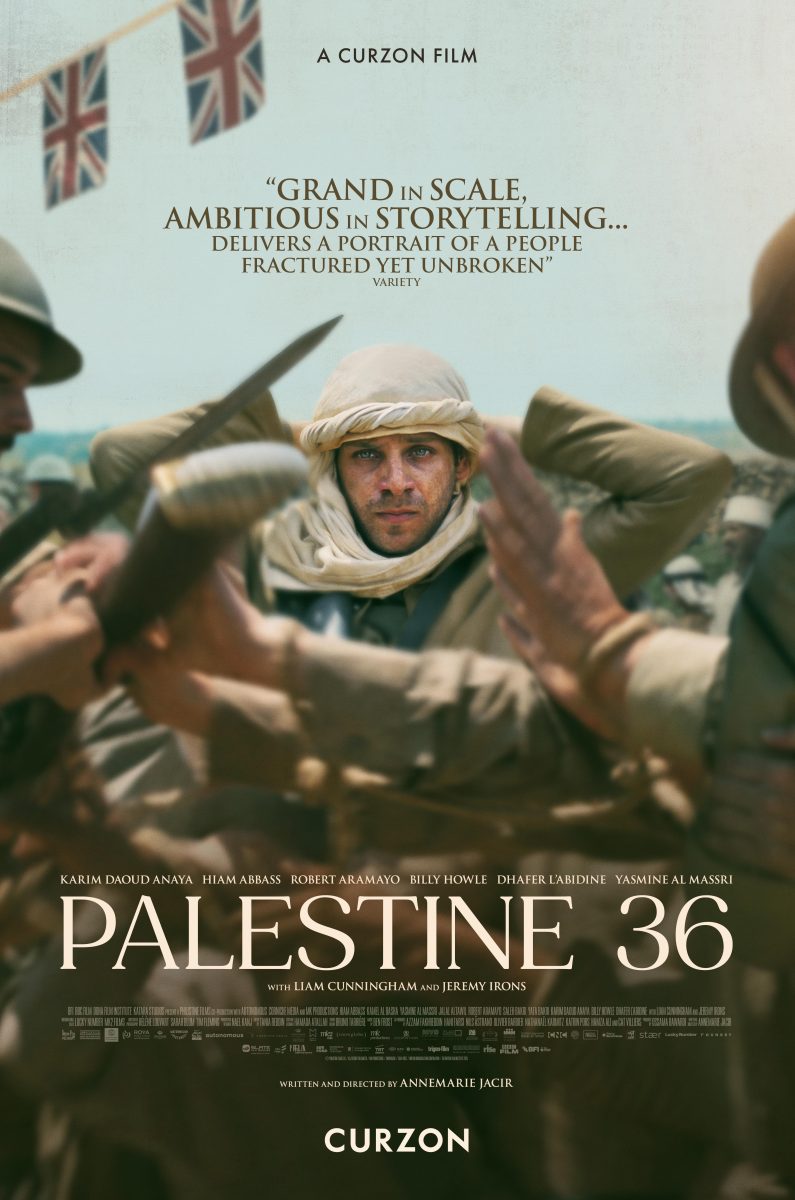
Palestine 36 (2025)
Written and Directed by Annemarie Jacir
Edited by Tania Reddin
Produced by Ossama Bawardi
Featuring: Hiam Abbass, Karim Daoud Anaya, Yasmine Al Massri, Billy Howle, Jeremy Irons, Lia Cunningham and many more.
As the death toll continues to rise in Gaza and across the region, Phil Ross wonders whether a film set in the 1930s can help us understand how it came to this, and why so many of us care so deeply about Palestine.
For many, this uniquely Palestinian lens on a largely overlooked uprising, sparked by land confiscation, biased employment policies, and escalating colonial cruelty, will be a revelation. Ten years in the making, shot on location in Palestine and Jordan amid repeated disruptions and delays, the film is an ambitious, richly detailed epic rooted in the 1936-39 Arab uprising against British colonial rule. Premiered at the 2025 Toronto International Film Festival in September, Palestine 36 was met with a 20-minute standing ovation, chants of “Free Palestine” and critical acclaim.

Yusuf (Karim Daoud Anaya), a young domestic worker in Jerusalem, straddles two worlds: the politically engaged Arab middle class he serves in the city, and his own rural village. Both, in their own way, fracture and erupt into a mosaic of storylines under the weight of British repression and the ever-increasing pressure of European immigrants escaping antisemitism.
The refined world of Yusuf’s urban employers – Amir Atef (Dhafer L’Abidine), a wealthy newspaper publisher, and his wife, journalist Khuloud (Yasmine Al Massri) – begins to crack under the strain of mounting unrest.
Professionally obliged to report on the turmoil around them, the couple must walk a delicate tightrope between truth and provocation. Their friendship with well-meaning British diplomat Thomas Hopkins (Billy Howle), only complicates matters, exposing deepening rifts between political restraint and the growing call for resistance.
Meanwhile, in Yusuf’s home village, loosely based on al-Bassa, the site of a real 1938 atrocity, British military repression escalates with chilling intensity. Daily life becomes a cycle of curfews, arrests, and raids, as colonial authority tightens its grip.
The community fractures as men are driven into hiding or armed resistance, while women, children and the elderly endure relentless searches, beatings and harassment. Veteran Palestinian actor Hiam Abbass is outstanding as Hannan, Yusuf’s potential mother-in-law.

When the Royal Ulster Rifles arrive, the cruelty reaches its peak in a harrowing sequence that reimagines the al-Bassa massacre, where villagers were forced onto a bus and made to drive over a landmine planted by British troops themselves.
Looming ominously over Yusuf, his home and his employers is the omnipresent and malevolent figure of Captain Orde Wingate (Robert Aramayo), an unconventional Christian Zionist whose belief in divine destiny fuels his brutal counterinsurgency tactics. During World War II, Wingate proposed the creation of a Jewish army to rule over Palestine on Britain’s behalf. He went on to establish the Gideon Force in Abyssinia and the Chindits in Burma, irregular units that operated deep behind enemy lines, before dying in a plane crash in 1944.
Politically, Palestine 36 naturally draws comparisons to The Battle of Algiers (1966), blending the harsh realities of colonial history with cinematic craft and artistry. But unlike Gillo Pontecorvo’s monochrome classic, the film makes powerful use of lush, colourised archival footage, offering a rare and vibrant glimpse of pre-Nakba Palestine society: daily life under military occupation, bustling streets and markets, and a cultural richness interwoven with Jacir’s unrelenting dramatic tension. It’s tantalising, fascinating and beautifully handled. And I longed to see more of it.
Like Michael Haneke’s Caché (2005), the film rumbles with an uncomfortable sense of foreboding, as if the next moment might unearth some new colonial cruelty, some lingering atrocity buried in silence but very much alive in the tortured sleep of those who bear witness.

Indeed, the wider historical context is essential. The British Empire reached its zenith in the aftermath of World War I, expanding its influence through the acquisition of former German and Ottoman territories. It had pledged support to Arab leaders for an independent state in exchange for help overthrowing the Ottomans, while simultaneously negotiating the secret Sykes-Picot Agreement with France to divide the region.
The duplicity was compounded by the 1917 Balfour Declaration, in which Britain declared support for a “national home for the Jewish people in Palestine”, without consulting its Arab majority population. And, in this sense, Palestine 36 sits uncomfortably alongside David Lean’s Lawrence of Arabia (1962) in providing the broad historical brushstrokes of our government’s long and damaging record of deception in the region.
For some, the depiction of European Jews fleeing antisemitism as alien, insular settlers implanted through British duplicity and violence to prop up a declining empire, will be deeply inflammatory. For others, it tells long-buried truths.

By 1948, when the Mandate in Palestine officially expired, Britain was bankrupt from the ravages of World War II. Its empire was unravelling and uprisings had begun across its colonies, including in Palestine, where Zionist militias had turned on British forces. As the imperial grip loosened, a new global order emerged. The age of American hegemony was beginning, and with it a new phase of Western dominance in the region, with Israel as its strategic foothold.
On 21 September 2025, the UK government officially recognised the State of Palestine. But no apology has ever been offered for Britain’s historic role in the country’s destruction and the displacement of its people, nor for the ongoing complicity that allows the machinery of genocide to grind on. In the darkened cinema as people sobbed, Palestine 36 did not ask for justice, it simply showed why justice is owed.
Palestine 36 is on limited release in cinemas across the UK – Book Now
~
Photography and trailer courtesy of Jake Garriock at Curzon Film
Words by Phil Ross. More writing by Phil can be found at his Louder Than War author’s archive.
A Plea From Louder Than War
Louder Than War is run by a small but dedicated independent team, and we rely on the small amount of money we generate to keep the site running smoothly. Any money we do get is not lining the pockets of oligarchs or mad-cap billionaires dictating what our journalists are allowed to think and write, or hungry shareholders. We know times are tough, and we want to continue bringing you news on the most interesting releases, the latest gigs and anything else that tickles our fancy. We are not driven by profit, just pure enthusiasm for a scene that each and every one of us is passionate about.
To us, music and culture are eveything, without them, our very souls shrivel and die. We do not charge artists for the exposure we give them and to many, what we do is absolutely vital. Subscribing to one of our paid tiers takes just a minute, and each sign-up makes a huge impact, helping to keep the flame of independent music burning! Please click the button below to help.
John Robb – Editor in Chief


Leave a Reply