
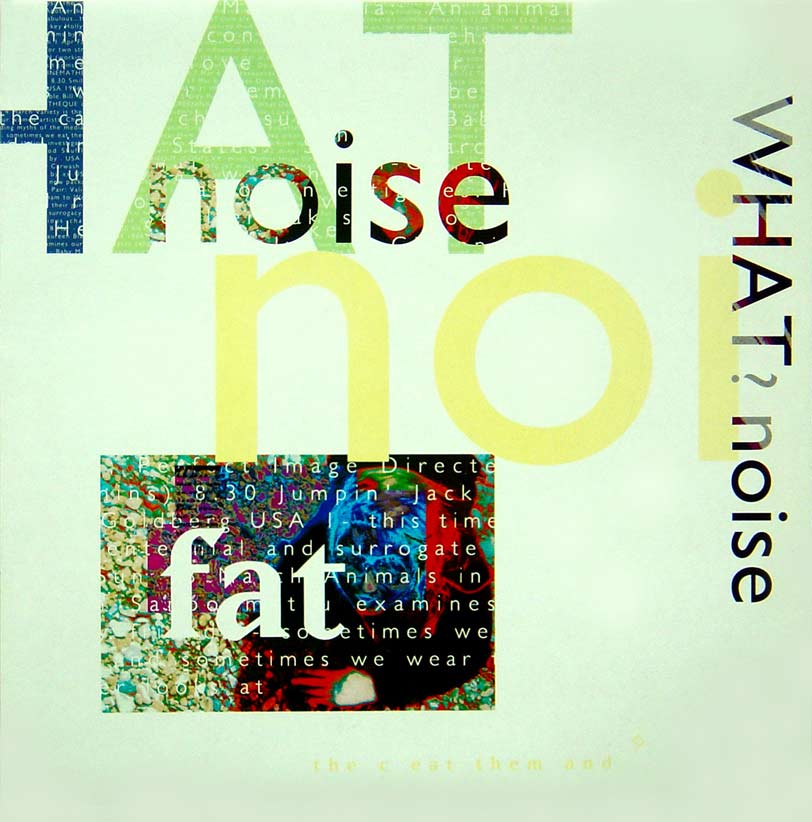
In the fourth of the series Lost In The Time Tunnel, Martin Gray revisits the debut album Fat by What? Noise, one of the great almost-forgotten albums of the post-acid house Manchester era, and finds that, more than 35 years later, the uncompromisingly dark neo-industrial grooves contained within still provide a compellingly disquieting listen, and all the better for it.
Between 1987-1988 something dramatic happened in Manchester. For so long a regional city always associated with the cliche of dark satanic mills, rain, dourness, industrial decline and an appropriately austere music scene to match (pick from any number of those ‘overcoat’ post punk acts you can care to mention, with the sole exception of Buzzcocks and The Smiths), this was the period when the archetypal greyness of everything began to give way to a gradual infusion of colour.
And this was all down to one place where, ironically, many of those aforementioned dour, overcoat-wearing post punk bands regularly played to a smattering of indifferent punters. The Hacienda club. Some time around the period 1986-87, resident DJ Mike Pickering had come back from the States (visiting Detroit and Chicago) and, along with another resident Greg Wilson (also a key DJ at rival club Legends) began to play white labels which introduced to the punters present at the time the very first exposure to House and proto-rave music.
The resultant regular house music club nights duly became the main attraction at this former yacht warehouse. Soon after the rise in popularity of the squiggly TR-303 sounds that became dominant ushered in the acid house era, and Manchester was at the forefront of this whole phenomenon. From 1988, Balearic club nights hosted by Pickering, Jon DaSilva and Graeme Park took off and saw the venue often packed to the rafters.
The Hacienda had effectively shaken off its old skin. Grey overcoats gave way to huge yellow smiley faces and Ecstasy was the new drug of choice. Within 12 months this transformation was complete and, along with a wave of bands – both electronic dance acts such as A Guy Called Gerald and 808 State as well as indie rockers like Happy Mondays and The Stone Roses – the city was re-branded Madchester (taken from the title of a Mondays EP). Cue all manner of affiliated acts and bandwagon jumpers coming along and hitching a ride.
If 1988 was the year that everything officially went Day-Glo amid the Second Summer of Love (as it was referred to by the music press), then one faction remained resolutely unperturbed and unaffected by all of those shenanigans. And for good reason. The location in question? Stockport’s legendary Strawberry Studios.
Step forward Martin Hannett’s studio assistant and production/engineering foil Chris Nagle. His credits appear on many of the albums released on Factory Records during the first half of the 1980s, but even he was getting itchy fingers by this stage and harboured the desire to put his technical and instrumental prowess into constructive use by working on some material of his own.
Along with his studio colleague and partner at the time, Julia Nagle (nee Adamson), he had already set about conjuring up ideas in 1986 for what would become his inaugural recording project titled What? Noise. Together with a third contributor and engineer at the studio, Tim Harris, they later decided to forego all of the current predilection for euphoric dance music and, instead and no doubt inspired by much of the bands whose albums he was assisting with alongside his mentor Hannett, focus on making music that was much darker and far less commercial, by means of an antidote to all of the prevailing Ecstasy-influenced sounds.
This bloodymindedness duly set What? Noise apart from many of the other acts around this time and the end result was a relative anomaly for 1989-1990. However, there were nevertheless a handful of other bands that were still trading on the darker undercurrent of the post punk era of Manchester’s past; notably King Of The Slums, Dub Sex (later reconfigured as Dumb) and the now almost completely forgotten Swivel Hips (who were only briefly active and released just a couple of tracks on split singles and compilations).
These bands were regularly featured in the pages of the local fanzine Debris that was started in the mid 1980s by another Hacienda DJ luminary, Dave Haslam, and were also live mainstays at the legendary-but-long-consigned-to-history venue The Boardwalk on Little Peter Street. Furthermore, their live performances were nothing less than uncompromising and incendiary, the complete polar opposite to some of the new bands that were beginning to emerge at the tail end of the 1980s who were embracing more upbeat dance-infused and electronic sounds.
Dub Sex in particular also featured Chris Nagle among their personnel during the 1980s, and it’s due to this long time association that both this band and What? Noise are often regarded as kindred spirits, as over time members of both bands would feature in each other’s ever-shifting line ups.
What? Noise’s debut Fat (which was released in 1990 on the One Little Indian subsidiary Brave) eschewed bright Italian house pianos and funky bass squiggles for the far less accessible and more abrasive rhythms and textures of industrial post punk. Chris Nagle and his charges piled on layers of distortion, corrosive sheet metal guitars, sampled feedback, ominous groaning bass lines, clanking percussion, jackhammer drum machine beats and sinister keyboard washes along with other incongruous and eerie samples…. creating a total sensory headfuck that is at once both suffocatingly oppressive as it is exhilarating. There really was no other album released that year which sounded quite like this one.
Some music papers at the time were unanimous in their surprise at such a defiantly confrontational record, surmising with words to the effect that many long nocturnal hours must have been spent at the studio, hermetically sealed from the outside world, doing everything within their available means to consciously sculpt music that is this impenetrable and punishing to the listener on first and subsequent listens. What? Noise indeed.
But to some, like myself, it’s a breath of fresh air. To be honest, I was never a fan of all those ‘hands-in-the-air’ Ecstasy dance anthems and I personally found all that Madchester stuff really shallow, derivative and trite (for instance, for me the only two essential Happy Mondays albums were their first two: 1987’s Squirrel & G-Man… and 1988’s Bummed, and I kind of lost interest in The Stone Roses after their debut album anyway). So when I picked up Fat and stuck it on the turntable, whacking up the volume control to ‘loud’ on the very first listen, I was immediately assaulted with this sheer wall of floor-quaking distortion which brought on two simultaneous reactions: grinning in ecstasy (no, not that Ecstasy!) like a Cheshire Cat and also wondering if I might need a hair transplant at the tender age of 24 as I could feel the searing guitars prickling and burning through my scalp.
This was such a glorious ‘fuck you’ to the prevailing trends. How could something so unremittingly dense and chaotic sound so novel and intoxicating at the same time, I pondered? The answer was simple: I reminded myself of the obvious – the main What? Noise instigator Chris Nagle is an engineer – a sonic sculptor, an architect of controlled chaos. Therein lies his wizardry I guess. Thoughts then turned to things like ‘how many tracks must he have used on his mixing desk to make the guitars and basses sound so fucking colossal and super weighty…?’ and ‘what was going through their collective minds when making noises that were so crushingly intense?’, and yet somehow I also sensed they were in all likelihood having loads of fun deliberately making everything sound as gleefully full-on and heavy as they possibly could.
The clues to the latter lie in the one word titles that almost every single track has been graced with. In fact, a few months prior to the full LP proper, What? Noise issued a four track EP first to test the water: that was titled Vein, but it also featured a track called Shit which comically opens with a deeply unsettling synth drone that sounds like it’s accompanied by the noise of toilet flush water swilling around the U-bend… or not.
On Fat – the album – there are the titles: Whip, Crash, Wobble, Taste, PoW, Nob, Core, Change, Eventually, Anybody, Taste, Obliv, Zombic, Vanilla…. It’s assumed that a few have little to do with the lyrics with maybe some exceptions, PoW being one notable example as it features a truly disturbing lyric inspired by Prisoner Of War (the PoW in question) television footage where the battlefield carnage is recounted at first hand by the traumatised observer, accompanied by a suitably visceral and deeply unsettling staccato arrangement that suggests horrifying PTSD flashbacks. Not the sort of music you would want to whack on at night to soothe frayed nerves, I would wager.
Album opener Change hiccups into action in insidious fashion before it soon detonates with a periodic avalanche of massively overdriven guitars and filthy fuzz bass, and it’s like being blowtorched around the face. The ensuing Obliv (as in ‘oblivion’) slithers into earshot with some sinister feedback squealings and monstrous growling bass and then proceeds to smother the listener with impressively eerie musique concrète effects that sit atop the foreboding, dank, clanking undercarriage. Any words – if you can make them out at all – are deliberately buried low in the mix. Zombic possesses a peculiar off-beat rhythm but then proceeds to come across like something off New Order’s already bleak-sounding Movement album, but consciously amplified and disfigured by several notches.
Wobble is probably the most immediate track here, graced by some strangely beautiful ethnic wailing samples that gives the track an almost eastern-sounding exoticism, albeit one that’s decidedly drenched in acrid fumes from the vicious and toxic blasts of guitars that punctuate alternately. The more spectral Core which closes the first half offers a bit of space, tempo-wise, but still sounds like a heavily amplified dirge that’s been kept awake for too long on a binge of Clive Barker and John Carpenter films.
Where the album really plumbs the depths of abject hopelessness, however, is on side two’s opener Eventually – ironically the one song where the words are most decipherable. It’s a descent into the abyss that crawls along at a sludge pace, doomed out, foreboding, and immensely downbeat, with massive snare hits drenched in reverb and a nagging two-note siren motif that serve only to accentuate and compound each uttering of existential despair (‘and all I have, will turn to dust…eventually’). The extended snapshot atrocity exhibit of pure horror that pervades PoW offers little respite – even allowing for the deliberately disquieting arrangement with slashing guitars and programmed drumbeats impersonating gunshots and vocals rising to near hysteria, whilst the almost proto-shoegaze canter of Crash provides a sort of perverse release via its refrain where Tim Harris exhorts for the waves to come crashing in over him: ‘wash over me, pour over me’. The mechanised beats pound like iron foundry pistons drilling into your cranium and you find it impossible to resist except to wallow in this glorious cacophony.
Make no mistake – Fat is also a kind of dance music – but not the sort of crowd pleasing dance music that typified so much of the resurgent club scene in the city and elsewhere (westwards along the M62, Quadrant Park in Bootle, north Liverpool, was one notable rival scene). Rather, What? Noise create a super-heavy, claustrophobic, dense and dirty post-punk dance music, scorched and blackened with a vehemently neo-industrial bent. If late-1970s Factory bands like A Certain Ratio and Blackpool’s Section 25 pioneered that dank, dark (post-PiL) industrial funk sound, then What? Noise simply adopted it and pushed the template and EQ settings further into the red by piling on all manner of studio embellishments to create this oppressive dislocation dance that serves as a statement of intent.
If there are any precedents to the weighty machine-beats heard on this record then they can arguably be found in what the On-U Sound crew were also peddling around the same time. Master producer/mixer Adrian Sherwood and the trio of Sugarhill musicians Doug Wimbish, Skip McDonald and Keith LeBlanc (now operating under the new collective name Tackhead) were brandishing as sonic weaponry a whole slew of 12″ releases that combined punishing percussive gunfire, deep dub bass and corrosive guitars, augmented by disorientating samples of warfare and conflicts to ram home the dystopian ‘end of the world’ political messages that comprised all of their material. Working with a diverse coterie of collaborators such as (ex-The Pop Group) ranter Mark Stewart, former Bristolian scaffolder Gary Clail and others, the Tackhead collective’s modus operandi lay in creating grooves that were brutal and uncompromising but perfectly of its time.
Fat remained What? Noise’s sole official album release as further new material was rarely forthcoming. Despite a new line-up a couple of years later, this time featuring Mark Hoyle (founder of Dub Sex / Dumb) as vocalist/guitarist to replace Tim Harris who relocated south west, and Jay Taylor (later of Gold Blade and Bonebox) on additional bass guitar, and a handful of live outings – notably supporting The Fall when they played Stockport Town Hall in 1992, very little was heard of the group and activity was sporadic and fleeting.
However, some 15 years later in the mid-2000s, a new label, Invisiblegirl Records, was founded by former key member Julia (now using her maiden surname Adamson) with the sole intention of issuing previously unreleased What? Noise material from the archives (a total of three further EPs that belatedly surfaced between 2006 and 2010) and also remastered versions of their back catalogue to date, as well as music from a roster of other artists. The label has a lot of entries of interest and can be accessed from this link. A brief history of What? Noise and their releases can also be found on this designated link to the band on the same website.
~
All words by Martin Gray. Further articles by Martin can be found on his profile.
A Plea From Louder Than War
Louder Than War is run by a small but dedicated independent team, and we rely on the small amount of money we generate to keep the site running smoothly. Any money we do get is not lining the pockets of oligarchs or mad-cap billionaires dictating what our journalists are allowed to think and write, or hungry shareholders. We know times are tough, and we want to continue bringing you news on the most interesting releases, the latest gigs and anything else that tickles our fancy. We are not driven by profit, just pure enthusiasm for a scene that each and every one of us is passionate about.
To us, music and culture are eveything, without them, our very souls shrivel and die. We do not charge artists for the exposure we give them and to many, what we do is absolutely vital. Subscribing to one of our paid tiers takes just a minute, and each sign-up makes a huge impact, helping to keep the flame of independent music burning! Please click the button below to help.
John Robb – Editor in Chief





Leave a Reply