
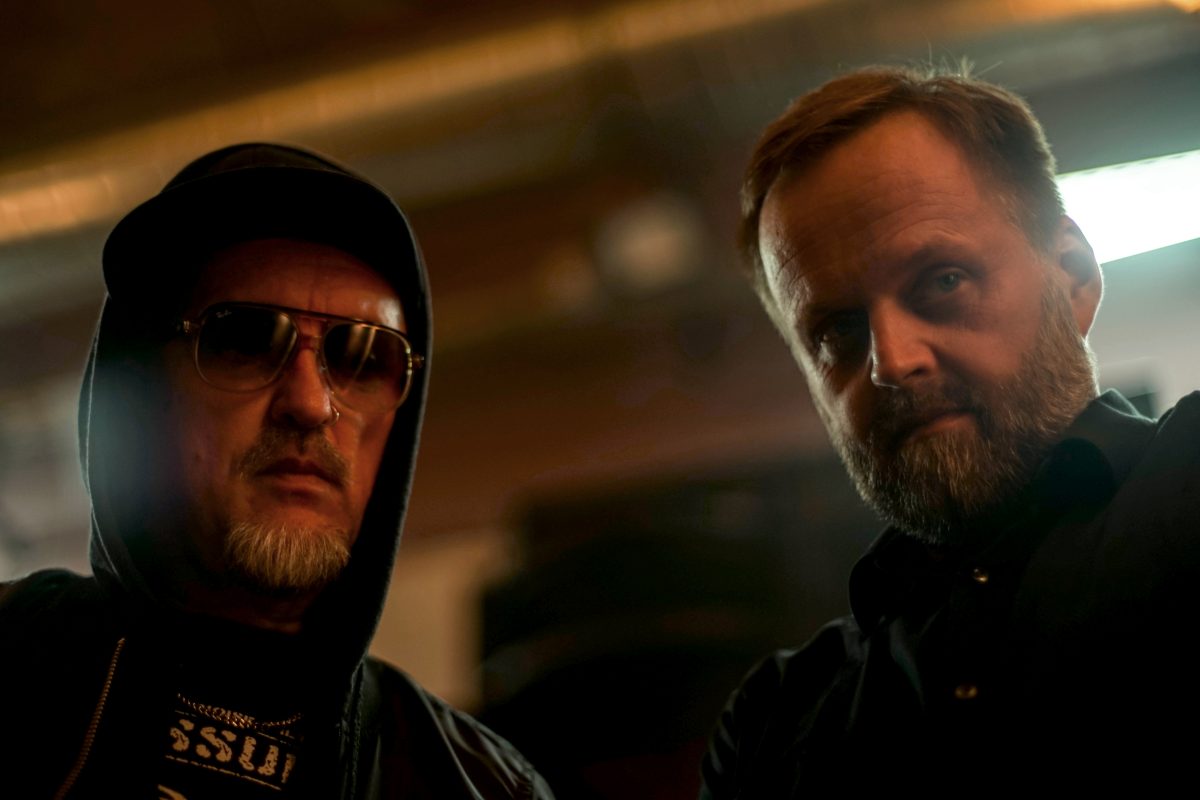
IMPLOSION: The Bug & GHOST DUBS
(Pressure)
Out now (ORDER HERE)
As individuals, the output of Kevin ‘The Bug’ Martin and Michael ‘Ghost Dubs’ Fiedler is founded as much on mindset as on mere music. On their split album, IMPLOSION, that shared psychology shudders in every inch of space, with interpretations of dub as we know it forever subverted into new realms of unprecedented depth: the potential fear of the silence. Interview with Kevin Martin and Michael Fielder by Ryan-Lewis Walker.
This is a new day, just like any other day.
Within the last couple of years, and bear in mind that this list is inexhaustive, widely esteemed footnotes in the careers of Kevin Martin or Michael Fiedler include this year’s Machine odyssey project by The Bug via Relapse, and his collaboration with Kenyan artist of ambient explorations, KMRU for their Disconnect album and its attached Otherness EP. Last year also saw the release of DAMAGED, the debut album by Fiedler as GHOST DUBS, and later on, its subsequent Extended Damaged Versions. Elsewhere, in 2023, we were slowly invited to empathetically descend into the spell of madness via Martin’s Black, a “musical eulogy to Amy Winehouse.” Then, under his Jah Schulz alias, Fiedler released the second chapter of his Dub Over Science project in the same year.
There’s more, of course. More deconstructions (Molchat Doma, Thom Yorke, Grace Jones, Earth). More renditions of weird things bent until on the cusp of breaking altogether. More collaborations, collectives and bands (Techno Animal, GOD, Warrior Queen, Dis Fig, Fennesz, Grouper and again, post-metal titans, Earth). More sound systems to erect as beacons of bass-beaten connections in the crackling ambience of the night (Iration Steppas, Blackboard Jungle, King Midas Sound). More record labels to release on (Echo Beach, Basscomesaveme, Phantom Limb, Relapse, and here, as with Ghost Dubs, Martin’s own imprint, PRESSURE).
It’s interesting then, that on IMPLOSION, the new album from Martin and Fiedler, the aural archetypes (although there are obviously plenty of curveballs, for behind every alias and band, is another corner yet to be turned: see the list above) ordinarily associated with The Bug, or Ghost Dubs, operate in the reverse. But by doing so, the creative and conceptual directions of either Martin or Fiedler are forever pointed forward: osmosis in crushing tandem.
”It seemed a no-brainer after I released Mike’s incredible DAMAGED album,’’ Martin states on the origins of the album. ”His tastes and chilled temperament dictated the idea, so I popped the question as I had become smitten by his immersive sound and felt I had found a soul brother. His enthusiasm and insanely fast work rate also made me even more eager, as I guessed he would also work with extra enthusiasm and would want to follow it up with shows. And whilst it was never overtly a sound clash between us, the competitive side of me knew Ghost Dubs would definitely not fuck about, and would bring severe weight, so I naturally wanted to see if I could go lower and heavier. Ultimately, I would call it a draw.”
AA”This might sound strange,’’ Fiedler adds, ”but when Kevin came to me with the idea of doing a joint album, I was sceptical at first. I wasn’t sure whether our two bass sound worlds would really harmonise. After all, we have very different approaches to dub, and the last thing I wanted for this project was to bend myself out of shape or be pushed into a mould that isn’t mine.”
Despite their unique deductions of what dub is, and is capable of, the predominant notions of the album appearing as some classic, some could claim cliched clash of production methods, competing opinions and personalities, the album serves as a perfect intersection of aesthetic idioms: a synthesis of functional differences, a dynamo of idiosyncrasies that feed off each other, rather than fragment into a horrific globule of disorderly confrontations. Ultimately, on IMPLOSION, something a far cry from competition is birthed, but something fantastically new starting to occupy the cavities of the archives of the dub technician’s mind, a space in the sound lab where ”something neither ”The Bug nor Ghost Dubs” would make on their own,” Fiedler states. ”And that’s exactly what happened: instead of competition, a shared space emerged where both worlds intertwine on equal footing.”
With Martin and Fiedler taking turns on each track to present a fantastic counterpoint to each other’s contemporary outlook on the wrecked, electronic strikes and circuit-smouldering dub formulas they have been exploring on their own uncompromising terms, on their own defiant turfs since day one, IMPLOSION is a shuddering incubator in the core of an empty room, but cannot be seen. It is a deep, insular space down ancient, endless rabbit holes burrowed in the bellies of a scorched industrial plain. But it’s a space that eventually climaxes to a total bodily collapse. A space that scratches and scrapes against the mechanical womb with granular malice and anxious, paranoid techno-dub dread. A space with a line drawn directly through it – a line occasionally breached, a bridge crossed, a threshold confronted together.
In Hyams Gym, Leytonstone, banging against the walls of a giant silo – excavating ancient ruins – business as usual for the Bug. It catches you off guard – disfiguring and tempestuous. Pulled to pieces like the ball joints of an action figure. Dissonant melodies are forged out of scolding mirrors, then fade like fibres – lingering drapes. Gobbled – gurgled – gagged. Forever frozen…hooked, to be precise. And along with the cheek, every pound of flesh with it.
AANext, Ghost Dubs takes us to In The Zone – witness a warpath of citadel-smashing bass and whirring machines. Witness all manner of textures and timbres, fidget and shuffle among a metallic reef of ectoplasmic electronics and amniotic atmospherics. At this point, we are ripped apart and reduced to nothing more than particles in the air. Granules. Grains of bones, glue residue and specks of bran in the bag.
Over the hill, from the bright visors of a world-devouring mecha droid comes Burial Skank (Mass, Brixton) – a heavyweight blitzkrieg of wrought, bass power and magmatic drum assault from the Bug’s uncompromising spree. Cascades of sirens gnaw through the void with the battle-bitten rasp of Remote Dub from Fiedler, inhaling the vapours soon after it. An unnerving ooze of workshop ambience lets the spirit of a machine-mangled MC bleed through their surfaces like spots of dark mould impregnating white walls. Embellishments of warped mechanical noises nauseatingly slice through a joint of meat covered in a family of flies, catching light on their jagged teeth, sawdust beats kick and awaken, and we are intoxicated by its muffled, sulfuric trail.
Following on from the IMPLODED VERSIONS EP, What we encounter on the album is so much greater, deeper, darker sense of suspended psychic groove. More than that, it’s a presentation of all sides: interlocking, multidimensional angles of the same space – a dreamscape of distant mirrors hung at different heights – bent into fragments the more we trespass through the unwinding corridors they guard.
And us? We walk as fools under the illusion that there’s more space above, in front, and behind us, but really we are turning into distant echoes of dissolving organs, ensnared in the reverse of what MACHINE’s powder keg boasted, and what DAMAGED hinted at, dripping into the mix which is now only reinforced at the hallucinatory forefront of dub sound design.
AA’”After releasing the MACHINE series, it felt like the right time to make an implosive album that could indulge in being insular and revel in its isolationism. I knew I wanted to make and listen to an album that thrived on its spaciousness and tension. That was a tribute to great dub albums of the past, but sought to try and extend my vision of how Dub could sound that was not intrinsically linked to Reggae, but still thrived in its echoes and shadows. I became obsessed with how far and low I could go with a bassline and the most minimal of ingredients.”
A new demonstration of minimalism, and resetting the coordinates of the previously deployed ‘floor weapons’ by a dial or two and instead, rather than annihilate space until all that hangs there are relics of memory and mortar, unsettling the prisms of space in the lacunas of society, it’s fascinating that both Martin and Fiedler attack and approach the concept of dub from different degrees – yet they are both in pursuit of the same target.
There’s the claustrophobic rawness and devastating minimalism of both their sounds twisted into the same writhing helix, that megaton weight and depth and wrath will always permeate what each of them does, but the methods of making that work are subtle and unique. Is it as clear-cut as the mechanical drive of Fiedler’s dusty techno to Martin’s isolationism that contributes to IMPLOSION’s flow?
It’s not that simple.
”I think we are both obsessed with the idea of dub music targeting the future, but in actuality, I think I wanted to somehow examine my past, present and future relationship with Dub,” Martin says. ”In terms of philosophy as well as strategy, I found it interesting that we both ended up stepping towards each other on IMPLOSION, without any prior discussion or pre-planning. I knew I wanted the album to be immersive and consistent, and not jarring in its contrasts. So I tamed some of the more confrontational/caustic sides of what I do as The Bug, to go in deeper on sound, and had been compelled for a while to reduce tracks literally to their barest essentials, and this record felt like a perfect opportunity to do so more extremely. I approached the idea conceptually first, then set about composing musical narratives.
AA”For me,” he adds, ”I feel Mike’s affinity to dub is indeed as passionate as mine, but if there’s a difference in approach, maybe its his use of loops, against me using live elements, and my ongoing obsession with tone and texture, may be more extreme than him, but really the differences are indeed subtle on this album as we both moved closer to each other’s turf. I felt Mike got heavier, and I got more minimal, and we located a suitably moody meeting point. His tracks appear sometimes more mechanised and techy perhaps, whereas my tracks feel more human in terms of mood and sound and atmosphere. But personally, I love how our borders are blurred on this release.”
From being a graduate of Germany’s new school of sound system reggae culture (”very active and dedicated”, ”heavily DIY”, a ”familiar and tight-knit world” of passion, rather than profit-driven projects) in the case of GHOST DUBS, or as Jah Schulz, IMPLOSION is also a reconciliatory site where borders of individual upbringings and scattered geographies are also blurred.
It’s in this reconciliation where we find the album’s distinct, dynamic power. Fiedler prefers to operate in states of exile from the city, a self-proscribed separation from the incessant bombardment of carnage they forever entertain us with, yet still able to wield the spectral residue that remains in their place long after the city has peaked. ”Big metropolises attract me and repel me at the same time,” Fiedler states. ”I love the places where cultures collide, where sounds emerge that would never exist without that exchange. I absorb that energy like a sponge. But to actually shape it into music, I need distance. Only when the hustle and noise fall away do I find the focus for the reduced, slow, almost bodiless dub that I make. The cities give me the impulses — but the real Ghost Dubs are created in retreat. In the end, it’s precisely this tension between sensory overload and silence that drives my sound.
AA”My experiences with sound systems didn’t directly influence the album – for me it’s more of a record meant for the living room, and most people will probably listen to it at home, at least when it comes to my tracks. GHOST DUBS tracks are, in their own way, shaped and influenced by sound system culture, but they would probably never be played by DJs on a dub sound system – they’re simply too experimental and not club-oriented enough.”
Martin, meanwhile is still attracted to the ”ceaseless motion of a city, and the chaotic possibilities of urban collision. The madness, contrasts, and infinite energy,’’ he says. ‘’My recent KRM releases were an outlet for me to think cinematically and visually, not just physically, and I think infecting The Bug’s previous style with heavy atmospherics in the foreground seemed like a good idea to me for IMPLOSION. I knew the Dub I wanted to explore on this album was sacred and secretive, and to see just how far I could probe heaviness and see just how low I could go, without picking up the noisier tools I had often reached for recently with MACHINE and FIRE. I wanted to amplify the potential fear in silences.’’
Hooked on a feed of Black Jade’s Contempo and TNT Roots/Earthquake as part of their Revelation series (Dub Harder Than Steel is also a wicked example of tripped-out, digital roots reggae), it was Martin’s worshipping the likes of Adrian Sherwood and Dub Syndicate that ”plotted how I could maybe infer such root-ical inspirations without resorting to cliché.”
The debut album from Dub Syndicate from 1982, the ‘ambience in dub’ album boasted an attitude of ‘less is more’, but still played with the possibilities of a mammoth sound, built of immense scale and delirious dimensions of impressive, intense physicality. It was Sherwood, eternally a guiding presence of Fiedler as well as Martin, firmly at their controls. “Obviously, there is a deadly band at its core, though, as opposed to me trying to get lost, solo, in my machinery and mixing desk. Being indelibly scarred by Post Punk by the likes of 23 Skidoo, PiL or Killing Joke, I craved the idea of unexpected fusions of style and sound. A challenge for me was, and is, how to transform electronics into warm, organic sources, and try and find my own voice again within their circuit boards and limitations.”
AA”I can’t really remember when Adrian Sherwood first entered my life. In the early ’90s I wasn’t particularly interested in reggae,” Fiedler says. ”I think it must have been some of his remixes — probably the non-reggae stuff he did for NIN, Depeche Mode, Primal Scream. I’m pretty sure a Living Colour remix record was the first Sherwood release I ever owned. And from that point on, he was simply always there. I’ve always liked producers who work outside their usual bubble — people who look beyond the edge of their own scene.”
Scouring beyond the edge of their own scene, there’s a deep connection between how both The Bug, and Ghost Dubs, come to constantly reconfigure their worlds, yet encourage partial, if not the entire dismantling of it for the sake of staying musically sane, and invested in the development of what their sound is capable of when about to burn up ahead of their own curve. Sonic signifiers remain stuck to the walls – hot, radioactive glyphs steaming on the surfaces they have passed through – but there’s something about IMPLOSION that feels like a match met, a spirit comrade found, a space to fill that has taken up until IMPLOSION to really do so.
AA”I definitely hear echoes of my Concrete Desert collab with Dylan Carlson [of EARTH], in terms of its urban explorations, and some of the recent KRM albums on IMPLOSION in terms of emotional range and wider sonic palette, and even my studio collabs with Will Burial on the FLAME releases. I think IMPLOSION gave me a chance to step back from the sound as weaponry approach I had pursued heavily on MACHINE, and allowed me to explore space and minimalism far more than on most, if not all of my previous Bug releases. Reducing and dubbing out many, many layers of sonic info down to rudimentary emotional tools capable of being completely lost in, was my personnel aim I guess.”
The gradual erosion of that ”sonic information” still means IMPLOSION is intense and powerful as one would expect, but the brutal, bulldozing weight that dominated MACHINE, is not the primary goal here, it’s ”just part of its overall whole.” With the Bug’s sound once described as Sun O))) holidaying in Jamaica, the machines on IMPLOSION weep in a different way than perhaps we, or Martin, or Fiedler have experienced before. IMPLOSION behaves as an opportunity to fulfil sonic desires in greater ways than touched upon in previous works. Imagine Boris recontextualised by Basic Channel, or imagine black metal band Burzum reconfigured via an artist on Burial Mix, and sure enough, you’ll find it’s in the hidden spaces, where a species of dub unlike any other is finally exposed.
In the last Ghost Dubs album, Damaged, we were internally eviscerated by a relentless spree of analogue ammunition and multidimensional sound design of a more tripped-out, techno fashion. A movement that only to adds pieces to the tank IMPLOSION routinely bulldozes us with that Michael allocates to his attraction in ”everything that sits slightly off to the side, sounds unfamiliar, and comes alive precisely because of that.’’
”For me, making music isn’t really ”composition” – it’s sound research,” Fiedler confirms. ”I’m looking for tones and textures that haven’t already been used a thousand times. Especially in dub techno, there’s often a fixed sonic palette that many producers rely on, and that uniformity bores me quickly. Implosion definitely gave me the opportunity to push this search even further. My work has often been described as extremely minimal, abstract, or almost at the threshold of pure sound art – full of noise, crackle, and that murky underwater feeling. But I’m not interested in simply referencing that tradition. I’m trying to distil dub down to its essence without letting it collapse into pure test tones.”
Hardly one to default to being an xerox of a blueprint, an interaction of an archetype, on Into The Mystic, Ghost Dubs – presents a caustic fission of minimal techno and eerie industrial drama. A voice, evolving into a melody the more we hear it repeat from a space we cannot see, rhythmically repeats to spellbinding effect. Metallic bleeps bleed and boil over. Meanwhile, a throbbing bass contorts between calloused groove and distorted radiation as the whole strike snaps and climaxes towards unholy weight.
This is a masterclass of dub-techno doing things on it’s own terms – and although influences are fine, so too are they inconsequential in relation to the whole experience.
Midnight is an discombobulating waltz of ketamine rhythms and kinetic sound effects, spiralling and unspooling. It feasts on society and regurgitates it at the edge. It claps and creates magic. A zombie-eyed groove from the dustbowls of the netherworld. Waterhouse – a disintegrating motif of blown-out beats are gradually joined by a jolt of entomoid electronics, erupts with nuanced discharges of static and harsh scrapes of acid-scattered noise. It’s slow. Stationary. Distilled. Uncluttered. It consumes everything into its crater and sucks out it’s organs like sherbet from a bag.
From the naked pulse of Dread (The End, London), eerily letting it’s carnivorous presence be known, be it in caves, and in underground carriages on the Northern line forced to grind to a halt, and Duppied (Brixton Rec), where we are subsumed by a seismic dose of dub direct from the sound lab, triggering sharp, hot zaps of vibrations to shoot up and down one’s vertebrae, the titles of Bug’s contributions to the album reflects ”more about impressionistic impact and eternal memories of crucial sound experiences”.
Barely-there, almost-awake, nearly-real, half-forgotten, a drop away from disappearing into the deep abyss, its in this series of spectral, psychogeographical recollections that gives gives the album a loose, conceptual thread, rather than just a disparate assortment of places the Bug has sonically scarred through his fierce, stuff-of-legend Firmly Rooted sound system. The locations latched onto each track reflect temporal tunnels, homages of noise on the lines between one moment and another, which made an indelible impression on Martin, be it the SUBDUB nights in Leeds, the Ram/Renegade Hardware events at London’s The End, or VALVE nights in Mass/Brixton where he was ”physically stunned” by the serotonin spear of Dillinja’s sets, or early DMZ parties where his own own tunes were being spun live by the likes of Loefah and Kode 9.
”I knew I wanted to address Dub as a music of spectres, and wanted to also further echo my past addiction to dub and sound system culture, ”Martin says. ”Of the venues I listed on the titles I think I only played half of those. But all of these places had a massive impact on me, either as audience member or musical protagonist. The first dub sound clash I ever witnessed was between The Disciples and Iration Steppas at Hyams Gym, and it literally took my head off psychologically, and probably re-arranged my DNA permanently. I had never witnessed such blatant, intense sonic warfare, outside of prime SWANS shows.”
AA”I look at Kevin’s club titles with a bit of envy,” Fiedler adds. ”So many legendary club names that I never experienced myself, but I’ve heard incredible stories about them or knew mixtapes from those places. It honestly makes me wonder where my own love and dedication to bass and dub actually come from. From the little tape deck in my childhood bedroom? Unfortunately, I didn’t have those sound system experiences, those ”masses,” during my childhood and youth.”
Out of those masses, Alien Virus (West Indian Centre, Leeds) presents a spectral torrent, an image of an echo in an empty container in a yard shoulder-to-shoulder with thousands more empty containers. It’s an incoming discharge punching craters into planets of steel and stone, a receding tide revealing the leviathan threat under its bubbling, silver surface. And as two minutes tilt into the third, a passage provided by a wash of woozy keys. We are immersed and without logical recollection of why our clothes are torn, are skin scarred in the electric chair of memory, obliterated like wiped banks of psychic data.
AAOn Militants (The Rocket, Holloway), we are guided into the twilight by a guerrilla dub-techno invasion composed of an axis eating into everything it pierces like parasites etching themselves into onyx monoliths sealed away in the deepest regions of countercultural subterranea. The occasional voice, feral and near-impossible to trace for more than a few seconds, emerges to recite tribal spells of mind-altering hypnotism.
Sound system culture is everywhere. It permeates every surface of a city camouflaged in black tarpaulin and bedazzling sheets of chrome. It bends and crackles like a transmission from a tower block interrupting the direction of the breeze. Sound systems create microcosms. They generate community entities that gather around it’s ancient pulse it’s in the climax of the London underground – the ambience before the eventual ambush of the rocketing carriage coursing through the various arterial tunnels taking one section of activity to another. It’s in the drama of construction sites and their jarring, rhythmic charges – of hammers and drills, dropping and exploding, gnawing and groaning, the concrete-ripping rumble, the clanging claws and aching cranes, the somnambulant silhouettes of hunchbacked giants, dazed in static and perpetually hung against the dystopian panorama.
The fundamental confession of Implosion is a boundless devotion to sound systems – the sound system as a subjective weapon. There’s a visceral, sensory nature to Implosion’s sound system, forever supercharged, humanoid, feral, angry. IMPLOSION, the body’s sound system – ambient in some ways: an incubator, yet a total sensory laser beam on the other, is a dominant, optimal demo of how dub-more than just a method to make a noise based in the roots, is used as a tool to excavate spatial ruins, to expose the dubious nature of society draped in surveillance, teasing out the termites of temporal rupture from the metalwork of a daydreaming city, and evoke visions past and future to plug into the sockets of the present. This is all a tool utilised to assist in what Martin refers to as ”a probe of haunted dancehalls, a navigator in a city of ghosts.”
”Maybe I’m just so far gone or deluded,” states Martin, ”but I honestly don’t see this album as just attacking or aggressive in any way at all. I see it as more of an examination of memory and loss. Of course its fuelled on massive b-lines, and direct rhythms, but for me, I hear it as an almost ambient listen, perversely. You can play these tracks over a rig and they sound ridiculously enveloping, but then play them quiet at home and they work as an ambient floatation. I guess its me addressing how and why I have reached the point I’m at sonically in terms of my increasing obsession with texture, tone and production. But also, emotionally in terms of allowing more sensitive input than the anger and catharsis fuelling many Bug tracks previously.”
An input at the interface of a constantly shapeshifting landscapes, palimpsests unsettled, sediments dispositioned, plates scraping against each other to unearth and resurrect pieces memory we wrestle from the photobooks and hard drives of late capitalism, IMPLOSION works to imbue the gaps left by the flaking jigsaw pieces of memory with something we can, for as long as we listen, and look out for it’s phantoms, feel as though it was real.
”Just as many venues have prematurely disappeared due to loathsome gentrification etc, and sadly many great artists like Spaceape and Nazamba, passed far too soon, I felt I wanted to amplify that sense of resonant loss on IMPLOSION, and inhabit that world of echoes and lost voices and locations. And ever since the initial baptism of fire via the Iration/Disciples clash, and attempting to attend as many early Iration performances and Aba-shanti sets as I could.
AA”Once you feel sound literally re-arrange your internal organs and experience how the primal power of low end at extreme volume can awe inspiringly overwhelm you, there is no turning back as far as I’m concerned. At best, you are oblivious to everything except the irresistible sound that sucks you into its vortex. No pain. No gain.”
This is a new day, just like any other day.
~
The Bug | Instagram | Bandcamp | Facebook | X
GHOST DUBS | Instagram | Bandcamp | Facebook
Ryan Walker | Louder Than War
Photographs | Iulia Alexandra Magheru ©
A Plea From Louder Than War
Louder Than War is run by a small but dedicated independent team, and we rely on the small amount of money we generate to keep the site running smoothly. Any money we do get is not lining the pockets of oligarchs or mad-cap billionaires dictating what our journalists are allowed to think and write, or hungry shareholders. We know times are tough, and we want to continue bringing you news on the most interesting releases, the latest gigs and anything else that tickles our fancy. We are not driven by profit, just pure enthusiasm for a scene that each and every one of us is passionate about.
To us, music and culture are eveything, without them, our very souls shrivel and die. We do not charge artists for the exposure we give them and to many, what we do is absolutely vital. Subscribing to one of our paid tiers takes just a minute, and each sign-up makes a huge impact, helping to keep the flame of independent music burning! Please click the button below to help.
John Robb – Editor in Chief



Leave a Reply