
GoGo Penguin | Daudi Matsiko | Rakhi Singh
Albert Hall, Manchester
2nd December 2025
Manchester’s Albert Hall buzzes as GoGo Penguin return home, fresh off a US tour and gearing up for their European run to promote their new album. Seven studio albums in, with a stack of EPs and live records to match, the trio arrive sharp and focused. It’s my third time seeing them, but the first with their new drummer, and the night feels like a true homecoming jolt: a room full of believers ready for that signature surge of neo-jazz, electronica, and rhythmic adrenaline.
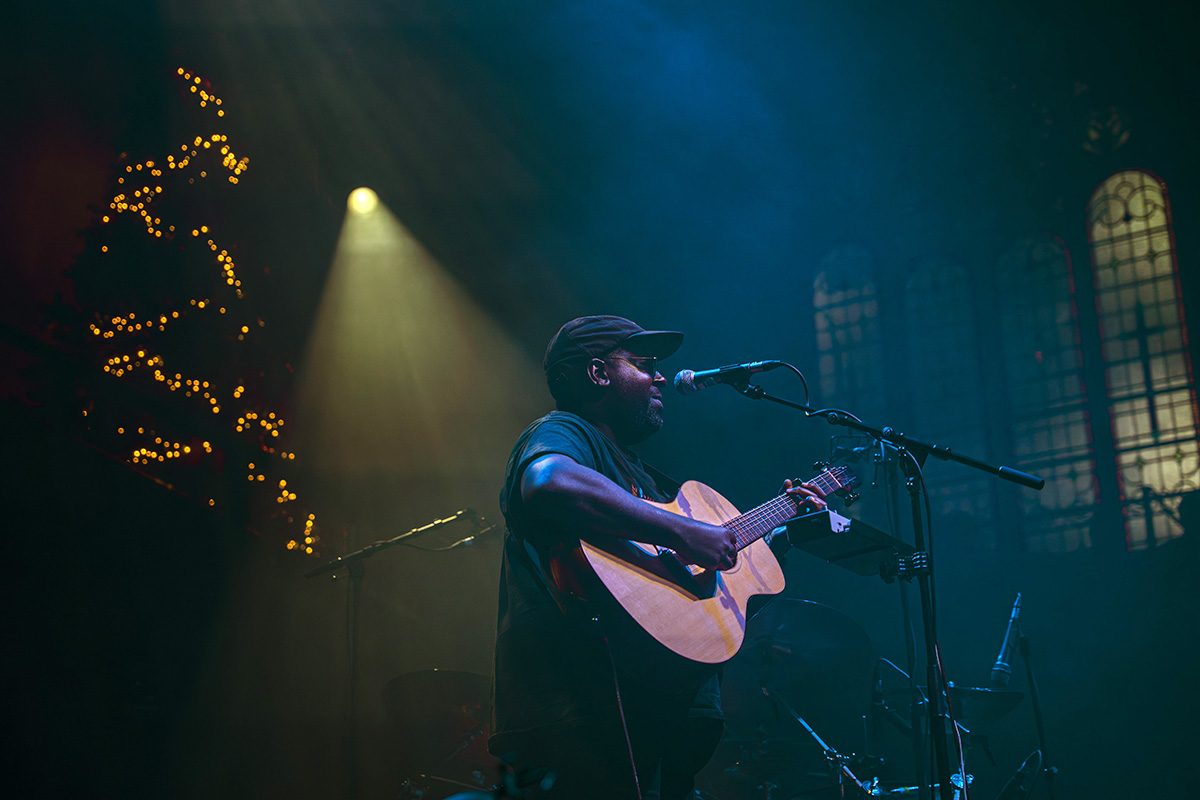
Daudi Matsiko opens with a quietly devastating and minimalist set. It’s just his delicate guitar lines and breath-soft vocals that, at first, feel almost too intimate for a room this size – but it’s not. The place falls into deep silence, drawn into songs that feel like whispered confessions. His modern folk moves into the spaces between notes, all intricate fingerpicking and honesty. The four-track set moves between his new EP Dead Bird – Tiger’s Dream, How Can I Love? – and standouts from album The King of Misery – Fool Me As Many Times As You Like, Hymn. The latter lands hardest, unfolding with a sharp, aching clarity. Between songs, he talks about the fragility of living with bipolar disorder and depression. “My friends and family surrounded me and picked me up. I wouldn’t be here without them,” he says with a sense of calm. Raw and quietly powerful, his set lingers long after the final note slips away, and the crowd responds with a well-earned swell of applause.
Under the cavernous glow of Manchester’s Albert Hall, where neo-Baroque arches loom, and ceiling details sharpen in the swirling stage lights, GoGo Penguin glide onstage to a crowd already vibrating with anticipation. Umbra unfurls with the kinetic pulse of Nick Blacka’s double bass, as if the room is about to enter a powerful collective breathwork session. Chris Illingworth’s piano enters with the same-key rhythmic tension, clean and angular, before beginning to climb what feels like a tower of scaffolding. The drive builds, and Jon Scott’s drums feel both mathematical and feather-light, holding the structure as the piano gathers confidence, then releases what feels like a kaleidoscope of butterflies that dive and weave through the framework. It’s a shimmering opening. Fallowfield Loops opens with a nod to Fallowfield’s hidden greenway, the old railway line cutting through South Manchester and running close to the iconic brutalist Toast Rack, which appears on the cover of the band’s latest album, Necessary Fictions. The track itself is instantly transportive, riding a slick glide of catchy bass, twinkling keys, and jazz-laced drums. Its repeated motifs give it a distinctly cyclic pull, with loops that feel like waves, almost. For me, the piece carries a synaesthetic lift and fall: rising and sinking with ocean swells while steering a small boat always just on the edge of balance. Then comes the tonal shift: the sea stills, the boat hovers over a swelling undercurrent marked by that quietly insistent double bass and the flicker of staccato piano, before it grows back into rolling waves again.
 From their fourth studio album A Humdrum Star, Bardo steps up the tempo, and beams of light scatter over the audience like rain. Illingworth’s piano glistens with a sharp brightness, spacious and wonderfully melodic. The notes dance like tiny incandescent particles flung from a fire into the night sky. This hypnotic motif continues until the sparks tumble down, as if pulled into an unseen abyss. It’s delicate and cosmic, with an energetic pulse. As it draws to a close, the cymbals build subtle tension, a soft simmer at the edges, while the double bass clings on in a gentle final murmur. The crowd are a mixed constellation of all ages, all mesmerised, blissfully melting into GoGo Penguin’s universe, swaying in a shared trance as firework-like patterns ripple across the ceiling. The trio seem to fold into their instruments as if becoming extensions of them. The Turn Within begins under a wash of purple light, subdued with a strange weightless quality, then tumbling forward with a frantic electronic loop. Then comes Break, its slow piano opening inviting the room into a suspended hush. Blacka steps in with intricately plucked lines, woody and raw, and when the sound drops to just his double bass, the crowd can’t help erupting into applause. The quiet builds to loud, and all three lock into each other, as roars and whistles rise to meet them.
Living Bricks Dead Mortar starts sparse, piano chords echoing over the subterranean hum of the bass synth and a steady heartbeat rhythm. And then in comes one of my favourites – What We Are and What We Are Meant to Be. It’s gorgeous, floating in on a halo of piano and soft, circular synth, everything melding across an irregular time signature. When Nick jokes, “If you see us looking like we’re really concentrating, it’s because we are,” the room breaks into a knowing laughter. The new album’s material is clearly propelling them into a bold phase. There’s even a hint of Mogwai’s cinematic swell here, and while the band are often tagged with Radiohead or Aphex Twin inflexions, it only brushes against that rhythmic terrain, with similar pulses and patterns, yet unmistakably its own sound. The set moves with the assurance of a band fully grown into its own skin, flicking back through the albums to show their evolution. Naga Ghost feels like shimmery paint dabs with its glorious arpeggios, off-kilter time signature and a restless rhythm. This spills into Silence Speaks, with its relentless shifts and airy phrases floating like dust in stage light. Sanctuary has a sparse, ethereal, haunting quality to it, until in steps Smarra, with a fast rhythm you can feel in your ribs. The crowd is utterly absorbed now, transfixed by the trio’s compelling craftsmanship.
 Ascent, from their EP Between Two Waves, lives up to its name from the Illingworth’s minimal triplet melody creating a pulse that feels part animal sprint, part bird-flight, part landscape waking up. It’s rolling and elemental, taut and focused, and surges before cresting into a powerful crescendo. Rakhi Singh of Manchester Collective is called to the stage for Luminous Giants, and her presence shifts the whole room. Her violin cuts through as the lead melodic voice, vibrant and full of fire, threading itself over the trio’s usual foundation of acoustic piano, double bass and drums. The result is a striking piece that swells beyond GoGo Penguin’s familiar palette and becomes one of the night’s undeniable standouts. Float drifts in upbeat but quietly dark; Murmuration lifts that energy into something ecstatic and whirring, transcendental lattice of rhythms locking together; Hopopono softens the landing, blooming like a colourful lullaby, gentle and glowing; And Parasite closes the run in a vivid cascade, bouncy-ball bursts of colour ricocheting between masterful double bass plucks and drums that leap with ferocity. The result of the band’s music never settles into one genre; it snaps between jazz, trip hop and electronica all fused with an uplifting ambience that feels fully alive.
The encore brings Daudi back in a velvety hush for Forgive the Damages, the trio keeping things minimal, with soft synth, piano pops, and a flicker of strings. Then Protest snaps the room awake, its coiled rhythms and mechanical precision driving the energy to a final high. And then, just like that, it’s over. GoGo Penguin slip offstage to a wall of applause, leaving behind a fizzy post-gig glow that clings to everyone in the room. It’s not just the precision or the rhythm sorcery that dazzles; they make it feel effortless and truly exhilarating.
~
GoGo Penguin can be found at their website | Instagram | and Facebook
Daudi Matsiko can be found at Soundcloud | Instagram | and Facebook
Rakhi Singh can be found at her website | Instagram | and Facebook
Words by Clare de Lune. You can find Clare on Instagram and at her author profile here.
Photos by Reece Pincher. You can find Reece on Instagram
A Plea From Louder Than War
Louder Than War is run by a small but dedicated independent team, and we rely on the small amount of money we generate to keep the site running smoothly. Any money we do get is not lining the pockets of oligarchs or mad-cap billionaires dictating what our journalists are allowed to think and write, or hungry shareholders. We know times are tough, and we want to continue bringing you news on the most interesting releases, the latest gigs and anything else that tickles our fancy. We are not driven by profit, just pure enthusiasm for a scene that each and every one of us is passionate about.
To us, music and culture are eveything, without them, our very souls shrivel and die. We do not charge artists for the exposure we give them and to many, what we do is absolutely vital. Subscribing to one of our paid tiers takes just a minute, and each sign-up makes a huge impact, helping to keep the flame of independent music burning! Please click the button below to help.
John Robb – Editor in Chief


Leave a Reply