
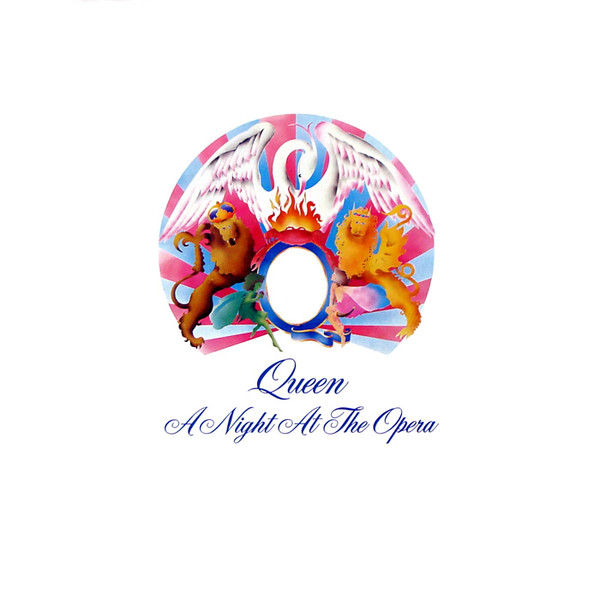
Fifty years ago on 28th November 1975 Queen released their fourth studio album A Night at the Opera which contained the game changing single Bohemian Rhapsody. Allen Maslen revisits…
A Night At The Opera followed Queen’s acclaimed third album Sheer Heart Attack, which was released exactly a year earlier. The concept of a top band releasing two studio albums in twelve months seems remarkable today, with most contemporary artists leaving a minimum three or four year gap between studio offerings. In fact the one year hiatus between ‘Heart Attack’ and ‘Opera’ was somewhat leisurely for the mid-70s; the group took a full five months in the studio and racked up a then world-record £40,000 in studio costs, (just under a quarter of a million in today’s money), making it the most expensive album ever recorded at the time.
So before we dive into the music, let’s have a quick look at that timeline to illustrate how much has changed in fifty years.
Extraordinarily, this fourth album came out a mere two years and four months after their debut album Queen, with the follow-up Queen II (identified by many fans as their last pure rock album) appearing only seven months after the first.
Indeed, after the triumph of ‘Opera’ they would follow with two further albums, A Day at the Races and News of the World, in the subsequent 23 months, giving fans a smorgasbord of six studio albums in just over four years.
One of the main reasons ‘Opera’ stands out from the impressive pack is of course the presence of the album’s closing track, Bohemian Rhapsody. This six-minute epic would sell 6.3 million copies worldwide, hit number one in eight countries, and is now the third highest selling single of all time in the UK, closely behind Elton John’s 1997 tribute to Princess Diana and the 1984 Band Aid fundraiser.
But there is more to this album, and in particular Bohemian Rhapsody, than cold unit sales and chart positions; I would go as far as to argue this song changed the course of music history.
In late 1975 the punk revolution was more than a year in the future, and the UK singles chart was drowning in a sea of complacent BBC friendly pop, and stuff our grandparents liked. UK chart toppers in that year had included novelty singles from Telly Savalas with If, Billy Connolly with D.I.V.O.R.C.E., Windsor Davies & Don Estelle with Whispering Grass, and (I wince as I write this), Typically Tropical with the stereotype laden Barbados, a song about a Brixton bus driver flying home to the Caribbean on Coconut Airways. They all genuinely got to number one.
Other acts who made number one in the months before ‘BoRap’ included The Bay City Rollers, Mud and David Essex; safe three-minute prime-time fodder across the board, more blow wave than new wave.
Yes, there have always been rebels lurking around the periphery of the mainstream, and Freddie and the boys may not have been the edgiest act on show, but the presence of chain mail, androgynous looks, leather and loud guitars did a good job of upsetting some of our parents, which was always a good start. More importantly, Queen showed burgeoning acts that they could work outside the usual norms, put a finger or two in the air to the establishment, and still get on the telly and pull in the punters. They were glam enough to appeal to Bowie fans, they were hard rocking enough to make Zeppelin devotees raise an eyebrow, and their musical dexterity endeared them to the prog fraternity.
Around the time ‘Rhapsody’ was released a group of London lads calling themselves The Sex Pistols were doing their first gig. Were they inspired by Queen’s disregard for the establishment rules? Or was the arrival of a six-minute song at the top of the charts the final straw and something needed to be done? Whichever, I believe when the Stranglers and the Clash stormed the castle a year later, their job was made slightly easier because Queen had already kicked a few of the doors in.
But more on Galileo Figaro later.
The point of this exercise is to examine A Night at the Opera fifty years on, listening to it as though for the first time, while knowing what we now know about what happened next.
The album opens with a brave move, arguably the least commercial track on the album: a Freddie Mercury composition, Death on Two Legs. One might assume the follow-up to Sheer Heart Attack would begin with something radio friendly, but here we have over a minute of brooding minor-chord riffage, followed by Mercury’s acerbic vocal attack on somebody who had evidently pissed him off to the extent that he calls him “a sewer rat decaying in a cesspool of pride”. Great line. We won’t go into further detail here about the tiff, because the somebody in question took the band to court over the lyrics, and an out-of-court settlement was apparently reached. A dark and courageous way to kick off an album.
Making an abrupt musical turn, Mercury’s jaunty piano leads us into the whimsical Lazing on a Sunday Afternoon, in which his vocal affectionately channels Noel Coward, before Brian May’s multi-layered harmony guitars hove into view. May had deployed this effect extensively over the previous three albums, but here he moves to a different level of slickness with a short snappy section to close the track, with a pantomimic slap of the thigh. Considering this was the pre-computer era of analogue recording, and the click track and ProTools wouldn’t exist for a further decade, this is a remarkable feat of musical engineering.
If Roger Taylor had never picked up a drumstick he would probably have fronted a rock band with his distinctive three-octave vocal range, which he wheels out to excellent effect in I’m In Love With My Car, although if 1975 had an award for least-convincing rhyming couplet, Taylor would have romped home with “With your hand on my grease gun / It’s like a disease, son”. But I’m just nitpicking, in an album without the ‘Scaramouch’ song to overshadow it, this might have become a rock classic in its own right.
Next up, the second of two singles drawn from the album, You’re My Best Friend, composed by bassist John Deacon. The song swings along pleasantly enough to get it into the Top Ten in six countries, propelled by Deacon’s own electric piano. It’s worth pausing at this point to consider Deacon’s role in this album. Firstly he hand-built the amplifier used by May throughout most of Queen’s early albums, which assures Deacon a lifetime’s discussion on gear geek chat forums. More pertinently, his bass playing is technically and musically sublime throughout. On a record where Mercury’s lead vocal, May’s flying guitar and a million vocal harmonies are jostling for space, it would be forgivable if the bassist were given a supporting role and asked to keep it simple, but over the course of the record he finds and occupies space lesser players would be unable to locate. It’s worth listening to the album and spending the forty minutes tuning the ears into the bass alone – it is a remarkably accomplished performance from a man who had just celebrated his 24th birthday. As a wise man once said, talent hits a target nobody else can hit; genius hits a target nobody else can see.
Keeping the mood light, Brian May’s acoustic ditty, 39, takes us down a country/folk wormhole where some stellar vocal harmonies await, especially Taylor’s stratospheric falsetto which predates auto-tune by more than two decades. It seems odd to be surprised that in 1975 a bloke sang into a microphone in perfect tune, but maybe that’s because so many of today’s performers would be banjaxed without studio trickery.
Kicking back into balls-out rock mode, Sweet Lady gets the head banging as effectively as the famous middle section of ‘Rhapsody’, with more than a little nod to Clapton, Baker and Bruce, and the slick changes of time-signature on the bridge section are complex enough to get a hard rock fan’s pulse racing. Canadian virtuosi Rush had recently released their third album and there was a new hunger among the hirsute denim hoards for this kind of anthem. It is further testament to Queen’s versatility in general, and the excellence of this album in particular, that this tune has never been much more than a filler album track. It deserved better. Oh, and top marks for the line, “You call me sweet like I’m some kind of cheese”.
Just when we think we are back on safe rocking ground, Mercury slips us another cheeky cabaret number, Seaside Rendezvous, which features a further Deacon bass masterclass. The song acts as an effective amuse bouche for the sombre eight-minute Prophets Song. Penned by May and exploring Jethro Tull territory, it demonstrates the curly headed chaps underrated brilliance as a lyricist – as if being one of the most iconic guitarists in rock history weren’t glory enough.
At this point – side two, cut two – the ears would welcome a duff track to provide relief from the relentless excellence. Instead, along comes Freddie’s Love of My Life, a vocal and piano ballad of tear jerking mastery. One genuinely forgets what a dazzling pianist Mercury was. If they ever remake the movie School of Rock, in the bit where teacher Dewey Finn doles out albums to his students to listen to for inspiration, he should give the pianist this track. Greatest frontman ever and also world class on the ivories? Stadium guitar god who is also right up there with the great lyricists? Consummate bass player who cobbled together one of the most admired guitar amps ever made? Sensational drummer who also hits higher and truer falsetto vocals than anyone else in the business? I mean, come on, give the other bands half a chance.
The penultimate track Good Company, allows May to flex his muscles as composer and arranger, culminating with what the sleeve notes call ‘guitar jazz band’, using his famous homemade electric axe to do passable impressions of clarinet and trombone. He gets to play ukulele as well, several decades after George Formby made the instrument famous and several decades before it became trendy again.
And so to the closing track, Bohemian Rhapsody. You don’t need me to describe the contents, but I will happily revisit my theory that it is arguably one of the most influential singles in UK music history. Crucially, it showed other bands that bowing down to the record company is optional. We mentioned Rush earlier, and four months after ‘Rhapsody’ hit the shops the Canadian trio released their own fourth album, 2112. Their record company had demanded shorter songs and a radio-friendly tone, so of course they gave them a 20-minute title track, taking up the whole of one side. Inspired by Bohemian Rhapsody maybe? Possibly, who knows?
A year or so later, when the early punk rockers were finding their feet, they were the first generation of bands who steadfastly shunned the bullying of the major labels who assured them the charts weren’t ready for this amount of revolution. Inspired by Bohemian Rhapsody maybe? Possibly, who knows?
And then there’s the small matter of the invention of MTV. The six-minute song length was never going to lend itself to miming on Top of the Pops (which if you are under thirty years old, was once a TV show – ask your parents about it!) so they made a film and single handedly invented the music video.
Would the punk pioneers ever give this much credit to an act as prog-rocky and glam-rocky and sword-and-sorcery as Queen? Who can say? But perhaps for context we should let the late great Farrokh Bulsara have the last word.
When asked whether A Night at the Opera had placed Queen in the same rock strata as the great heavy rock bands of the era, he replied: “Led Zeppelin darling? I think we’ve got more in common with Liza Minelli.”
Magnifico-o-o-o
~
Allen Maslen writes for Louder Than War and this this is his author profile He leads acclaimed folk/rock band, Meet On The Ledge – This is their website and this is their Facebook.
A Plea From Louder Than War
Louder Than War is run by a small but dedicated independent team, and we rely on the small amount of money we generate to keep the site running smoothly. Any money we do get is not lining the pockets of oligarchs or mad-cap billionaires dictating what our journalists are allowed to think and write, or hungry shareholders. We know times are tough, and we want to continue bringing you news on the most interesting releases, the latest gigs and anything else that tickles our fancy. We are not driven by profit, just pure enthusiasm for a scene that each and every one of us is passionate about.
To us, music and culture are eveything, without them, our very souls shrivel and die. We do not charge artists for the exposure we give them and to many, what we do is absolutely vital. Subscribing to one of our paid tiers takes just a minute, and each sign-up makes a huge impact, helping to keep the flame of independent music burning! Please click the button below to help.
John Robb – Editor in Chief


Leave a Reply